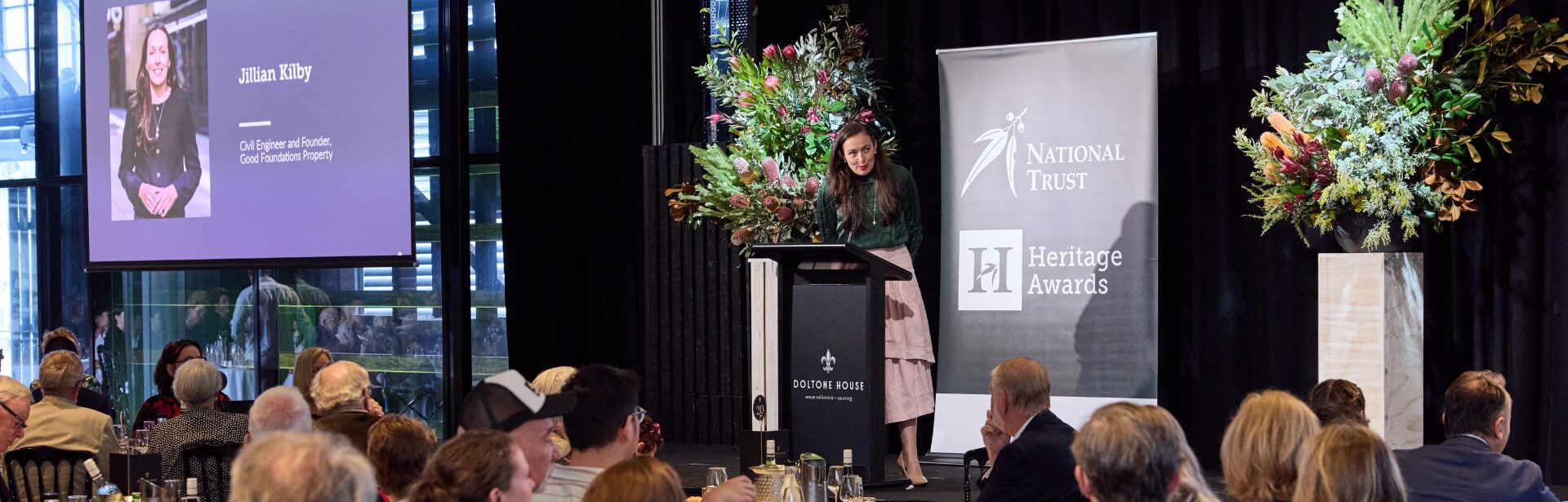
The keynote speaker at the 2026 National Trust (NSW) Heritage Awards, Jillian Kilby is a Civil Engineer with a Master of Business Administration and Master of Public Policy from Stanford University, the founder of Good Foundations Property and a visionary leader in the realm of adaptive reuse and sustainable architecture.
At the forefront of rethinking how we adapt and interact with historic spaces for modern use, Jillian’s diverse experience spans both public and private sectors. Through her work she addresses issues such as urbanisation, sustainability, and social impact, while ensuring the rich heritage of our state’s built environment continues to serve future generations. Here we share Jillian’s keynote presentation from the 2026 National Trust (NSW) Heritage Awards ceremony.
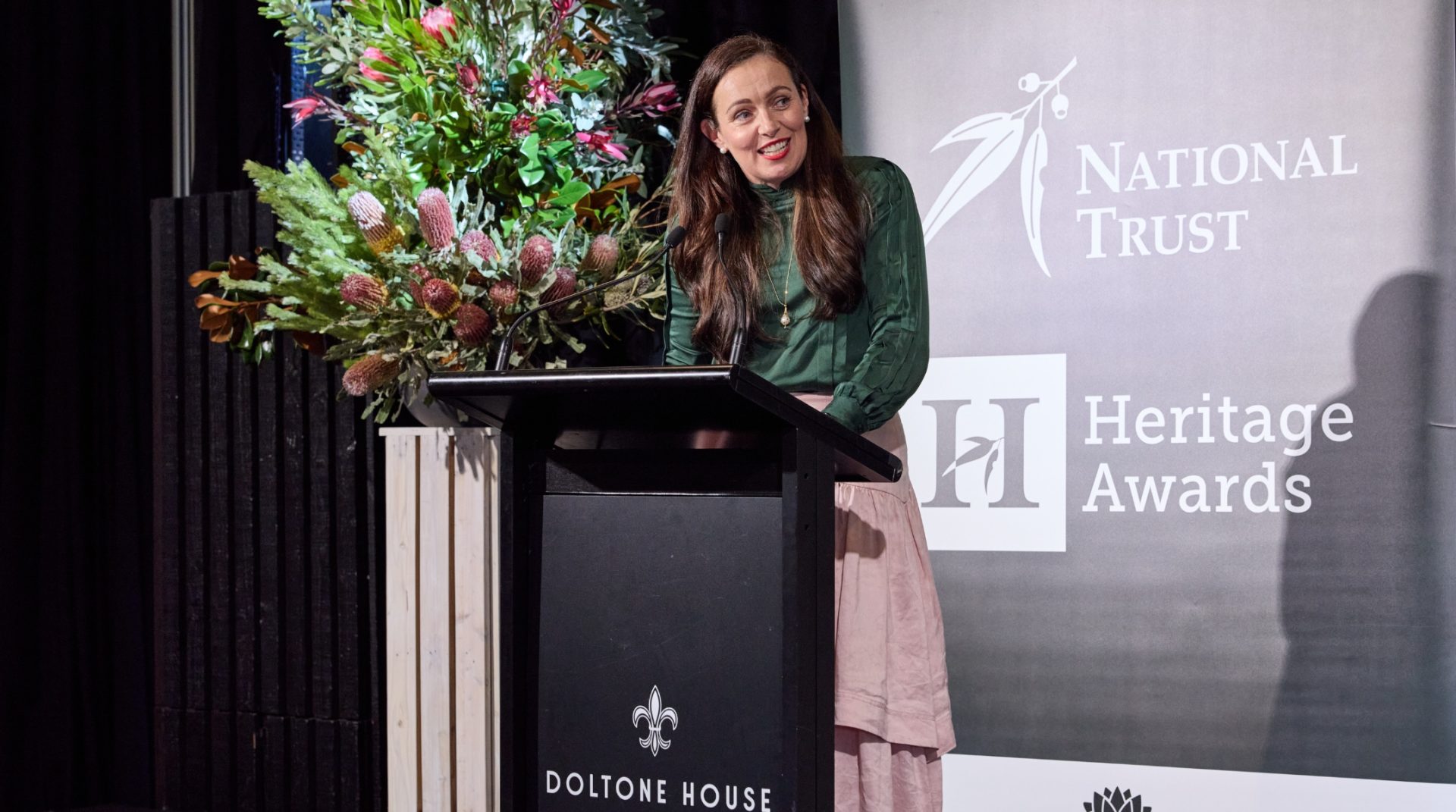
2026 Keynote
One of my early memories is of a wrecking ball beside my kindergarten classroom and watching the Brigidine Sisters timber building being taken away on an oversized truck. Spared from demolition.
Clearly, we in this room care about buildings. But have you ever wondered if people in general care about buildings? I believe every building has a story. And more than that, I believe people connect to buildings through moments and memories.
Moments when we walk past, walk in, look up and remember:
- The heritage rotunda where you were married,
- the building in which your grandfather had his dental practice,
- the Council Chambers you pass each day on your way to work,
- the bank at which you opened your first savings account.
I’ve learned that heritage matters most when people can see themselves in the story of a building, an artefact, a piece of land.
A career shaped by adaptive reuse
One of my favourite memories of my career was in 2006 as the Project Engineer for the refurbishment of Number 10 Towns Place. The heritage architect, Otto Cserhalmi, showed me around the Walsh Bay Wharves, explaining to me his philosophy that:
- If the fabric is old, protect it. Celebrate it.
- If the fabric is new, then make it distinguishable as new. Let the modification be part of the story of the evolution of the building’s form and function.
- In other words, never fake old.
I found joy in discovering the history and satisfaction in the legacy of restoring Number 10 Walsh Bay. That project was my first connection to these awards, where we were finalists for Adaptive Reuse.
Fast forward a decade and that experience led me to lean into this passion and purchase my first heritage building in 2018, an old post office in Dubbo built in 1886 by William Moffat and designed by colonial architect James Barnet.
I added to my adopted Walsh Bay philosophy:
- work collaboratively for approvals,
- respect trades, and
- remove the pigeons before painting.
The clock tower was transformed into a coworking space, no longer facilitating communication by Australia Post, but adapted to facilitate connection for the start-up community where it created significant economic impact. Our first tenants were women seeking an off-farm income in 2019, the worst drought on European record.
I went on to purchase a Cordial Factory and Ice Works in Narrabri, the former Australian Joint Stock Bank in Dubbo and the former Union Bank in Wagga Wagga. All Local-or-State-Listed heritage buildings, now renovated and adapted for modern commercial leasing.
Their significance is not only architectural.
- One froze rabbits that were shipped to the Western Front in World War I.
- One still keeps time for the town, the bell striking every hour.
- And one was the registered office of one of Australia’s first female architects in 1938.
These buildings matter because people can find themselves in them, and that brings me to what I want to talk about today.
People.
Who are we building for?
As someone who protects old buildings, I often wonder why we are so determined to knock down and rebuild, and who are we really building for? English designer Thomas Heatherwick says of many modern buildings: “We don’t look at them. We don’t photograph them. We wouldn’t fight to save them.”
And yet these buildings were built for people.
So if we don’t remember them, if we don’t feel attached to them, if we wouldn’t fight to save them — what are they doing to us?
Why buildings affect us
There has been some interesting work in this space. A researcher named Colin Ellard ran an experiment in Lower Manhattan. He walked people through two streetscapes. One was a long, blank glass façade stretching an entire block. The other was varied and human-scale, with doors, windows, texture, cafés, old and new buildings together.
Participants wore sensors and were asked to rate their mood along the way, and they said they felt much the same in both places.
But their bodies told a different story.
Their physiological responses told a different story. Along the blank façade, people showed signs of disengagement and discomfort; in the more varied street, their responses suggested greater engagement.
What interests me is that our bodies respond to buildings before our minds do.
We feel our built environment.
I recall walking around the clocktower late in the evening after trades had left with only the outside streetlights illuminating the space. And I used to tell people about this unexplainable feeling I had inside the building. I felt safe, I felt good. The research now backs this feeling up.
Today, we lean towards building new buildings ‘for people’ and ‘for sustainability’ over investing in adaptive reuse of our iconic cornerstones. We are replacing buildings that make us feel good with buildings that perform well, and assuming that trade-off is okay.
Rethinking sustainability
We’ve seen Government, bank and professional services leave landmark heritage buildings over the past few decades. Often, the attraction of new commercial buildings lies in the Green Star and NABERS ratings they offer. These ratings have recently begun incorporating embodied carbon calculations; however, we still don’t weight embodied carbon in a way that meaningfully changes tenant or investor behaviour.
I often look at the brick, slate, sandstone and timber in my buildings and think: This was installed in the 1880s. Before diesel engines. Before concrete pumps. Before ‘sheeting everything in glass’ was a thing. These materials arrived by horse and cart from local sources.
And they are still there.
Meanwhile, many modern commercial buildings are demolished or substantially rebuilt every 50 to 60 years. So, when I stand inside a heritage bank built in 1884, I realise something extraordinary: That single building has already outlived two or three entire modern building cycles.
Think about that.
On the same parcel of land, many developments would already have been demolished, sent to landfill, rebuilt, and fitted out again – two or three times over. Two or three cycles of concrete, steel, glass, plasterboard demolition and waste. Australia’s sustainability frameworks still reward operational efficiency more visibly and commercially than they reward carbon preservation through adaptive reuse.
I wonder how we might better reward tenants for:
- the embodied carbon already stored within existing buildings,
- the landfill avoided by not demolishing them,
- the carbon saved, by not rebuilding on the same parcel of land, two to three times in the last century?
Around the world, incentives are being experimented with, including ratings, carbon credits and tax credits.
While volunteering on the Real Estate Committee in 2016 at Fort Mason in San Francisco, I learned about the Californian 20% Historic Tax Credit on rehabilitation expenses, which can be stacked with the US Federal Historic Tax Credit for an additional 20%. That means, for every one dollar spent on preservation, a 40% tax credit can be applied, on top of the depreciable capex. In some cases, these credits can materially offset the cost of preservation works and make adaptive reuse more commercially viable. Imagine if this incentive existed in Australia for preservation, energy efficiency upgrades (such as for double glazing windows, new HVAC / LED lighting) and accessibility upgrades for people with disability in heritage buildings.
Some Governments offer property tax relief for owners subject to conservation agreements, while in NYC, landmark owners can sell unused development rights above their buildings (air rights) to nearby developers. The heritage building is protected, and some of the lost economic value is recognised. These policies acknowledge that preservation creates public value, and that heritage owners should not carry that burden alone.
Back in Australia, I wonder whether we could measure the lifetime carbon impact of a parcel of land and weight that more heavily within NABERS and Green Star ratings. Because, on many heritage sites, one building has served continuously for more than a century. Whereas nearby sites may have seen two or three cycles of demolition, landfill, reconstruction and fit-out.
With a higher NABERS ratings based on “lifetime embodied carbon over the land”, could we encourage major tenants – including government, banks and professional services firms – back into our iconic heritage buildings? And with their presence, it will be easier to maintain and protect our heritage buildings.
Because this is not an argument against sustainability. It is an argument for broadening how we define it.
Giving buildings a future
I would like to finish where I started.
Years after watching that building being trucked away from my kindergarten, my parents took me to find it. We drove down a long gravel driveway in the Hunter Valley and there she was.
Restored. Beautiful. At home.
That building is now The Convent Hotel. People stay there. Celebrate there. Get married there. Meet there. More people have created memories in that building because someone decided it was worth saving.
For me, heritage preservation is about giving buildings a future, so their stories can be told, and new memories can be made, for generations to come.
2026 winners of National Trust (NSW) Heritage Awards
Discover the inspiring projects and extraordinary individuals recognised for their contribution to heritage this year.
 Facebook
 Linkedin
 Email
Email