The National Trust (NSW) welcomes the news that Glebe Island Bridge will be conserved and reactivated as part of the NSW Government’s Bays West Development Redevelopment project.
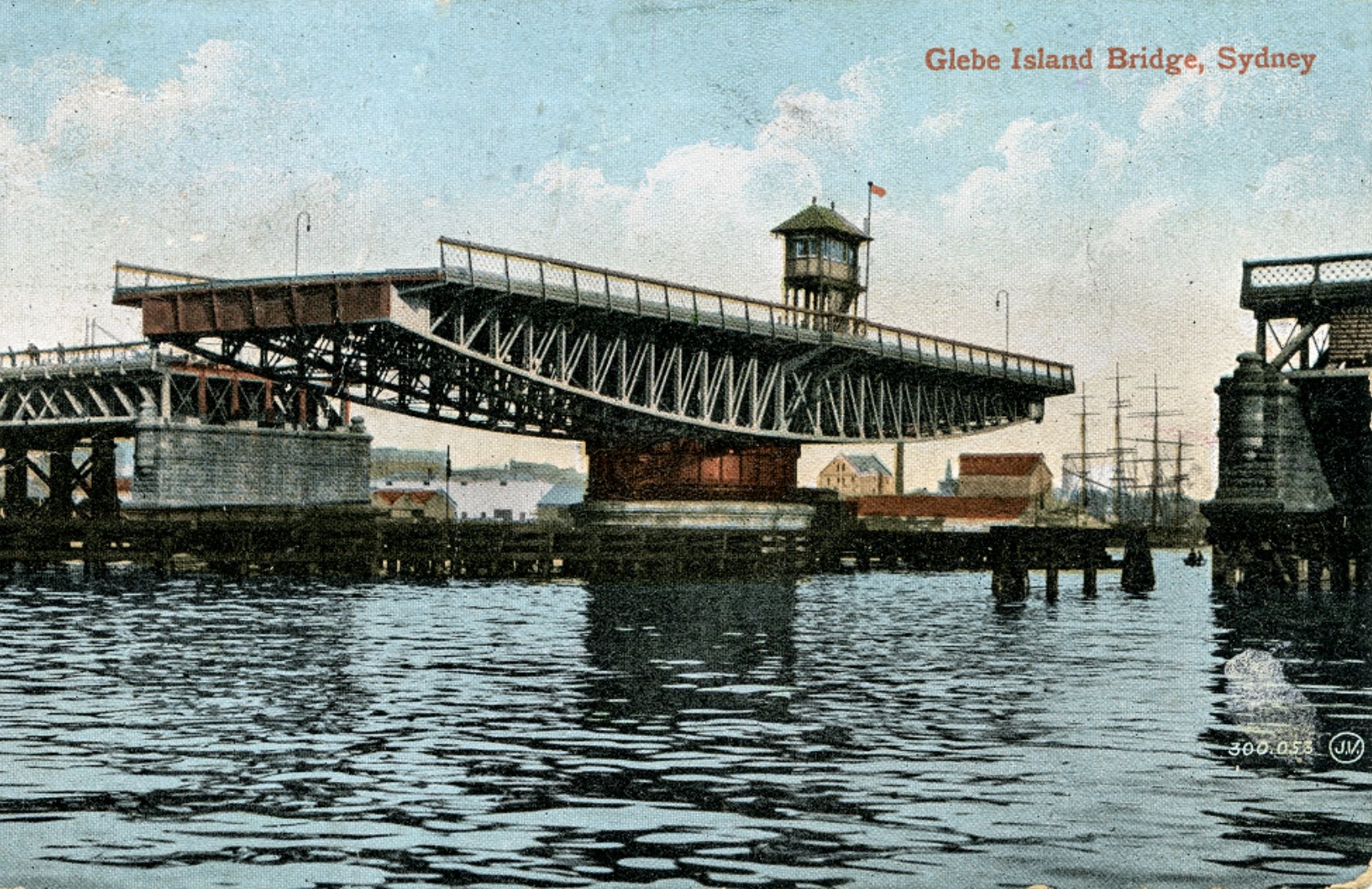
History
The first Glebe Island Bridge was constructed c.1861 to service the increased traffic to the new Glebe Island abattoir. Constructed of blackbutt timber and with a hand-cranked manual lift-span, by the turn of the century this structure was in poor repair and in need of replacement.
Developed as the final part of an 1880s plan known as the ‘Five Bridge Route’ to link the city across the water (at Pyrmont Bay, Glebe Island, Iron Cove, Gladesville and Fig Tree) the new Glebe Island Bridge was of a far more sophisticated design than its predecessor.
Designed by the Engineer-in-Chief for bridge design from the NSW Department of Public Works, Mr Percy Allan (1861 – 1930), the new Glebe Island Bridge was a unique design that generated international interest. A brilliant engineer who was also heavily responsible for the sewerage systems in Sydney and the Hunter, over his career Percy Allan designed over 450 bridges in NSW, many of which – including the Pyrmont Bridge and Tom Ugly’s Bridge over the George’s River – are still in service today.
Built by the contractor H McKenzie and Sons, the bridge was officially opened on 1 July 1903. Utilising the latest technology and being among the largest of its type then constructed, the Glebe Island Bridge employed what was considered to be one of the world’s first electrically operated swing spans, with power supplied by the nearby Ultimo Powerhouse. When the central steel span swung open on its massive central pier, the unique design allowed for vessels to move inward and outward at the same time.
The Glebe Island Bridge operated with little interruption from 1903 to 1995, when it was decommissioned upon the opening of the adjacent ANZAC Bridge. The bridge was in sound, operable condition at the time and was assessed as being too significant to be demolished.
The National Trust (NSW) listed the Glebe Island Bridge on our National Trust Register in 1987, and it was also added to the State Heritage Register in 2013.
Since it was decommissioned, Glebe Island Bridge has remained closed and unused for the past 30 years and has fallen into a state of disrepair. The National Trust has called for its repair and conservation (re-activation) many times over the last decade.
What’s happening now
The NSW Government’s Bays West Development Redevelopment project has recently been announced. Currently an industrial area and working port, the site located adjacent ANZAC Bridge is proposed for new housing, serviced by the upcoming Bays West Metro Station.
The Glebe Island Bridge sits adjacent to this site and has been identified as opportunity to link the new suburb to the city – a proposition put forward by the National Trust on numerous occasions. The NSW Government has announced that the bridge will be restored and turned into an active transport route for pedestrians and cyclists, linking Rozelle and Bays West to Pyrmont and on to the city.
While the National Trust remains concerned about heritage conservation throughout the Bays West site, we welcome the news that this project will see the conservation, maintenance, and re-use of the historic Glebe Island Bridge. Heritage is often best cared for when it is actively used.
Stay up to date with developments on this issue and read more about our campaigns and advocacy work by subscribing to our monthly email newsletter.
