On Friday, 8 May 2026, a public hearing concerning the Senate Foreign Affairs, Defence and Trade References Committee’s inquiry into the management of Defence estate assets was held in Sydney. The hearing followed an announcement by the Federal Government earlier this year of plans to sell Defence sites across Australia.
The National Trust of Australia (NSW) delivered its position at the hearing, calling for historic Defence sites to remain in Defence ownership. Read our speech to the inquiry below.
The National Trust is Australia’s leading heritage conservation charity, and the custodian of numerous historic properties. The National Trust’s 20,000 members and over 1000 active volunteers take very seriously our responsibility to advocate for heritage and our vision to bring the heritage of NSW to life for future generations.
It is with regard to the four particular heritage sites identified for disposal in NSW that I wish to speak today. I will take our submission dated 17 April 2026 as read, however I do want to reinforce the point that, despite being listed in the material produced by the Defence Department as a “potential partner to support heritage protection strategies”, the National Trust was never consulted during the audit process or prior to any of these announcements being made.
‘Heritage’ is an important word. It has its roots in Latin (to inherit), but equally I think it is important to consider it as something we pass on. The former Prime Minister of Australia, Paul Keating, has noted this in relation to this proposal that “Defence holds them in virtual trust on behalf of the nation.” [1]
We are all the inheritors of this National Estate.
In 1970, Gough Whitlam stated that “[The Australian Government] should see itself as the curator and not the liquidator of the National Estate.”[2] In the subsequent report into The National Estate, the Honourable Mr Justice Hope summed it up beautifully in the first paragraph as “the things that you keep.”[3]
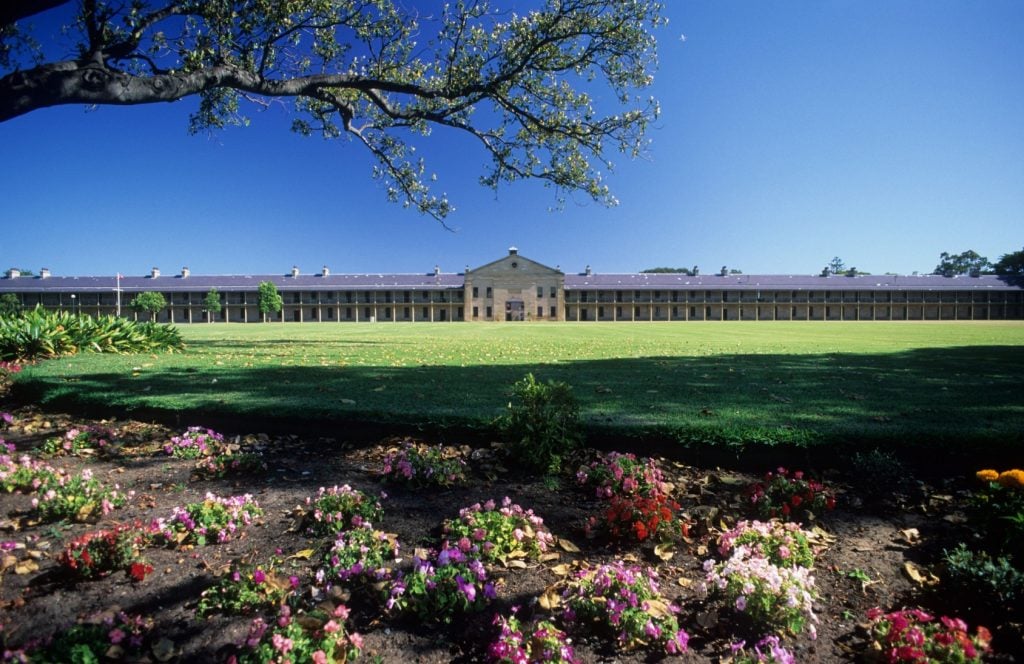
We should keep Victoria Barracks. We should keep Spectacle Island, Lancer Barracks and HMAS Penguin. They should not be sold.
Chapter eight of the report of that committee from 1973 deals directly with the role of the Australian Government as property owner:
8.3 As an owner of National Estate property [The Australian Government] has the opportunity, indeed the duty, to set an example for the rest of Australia.
The report goes on to say:
8.35 Some property now held for Defence purposes might be more suitably used for other purposes, Australian Government or State. The main principle is that the land owned by the Australian Government should be put to its best community use.
The National Trust’s position on Victoria Barracks, Lancer Barracks, Spectacle Island and HMAS Penguin is therefore consistent with advice provided to the Federal Government over 50 years ago – keep these sites in public ownership for the benefit of all Australians.
In the summary paper for Delivering the Future Estate it stated: “People are, and will remain, Defence’s most important capability. The recommendations focus on enhancing Defence work environments, ensuring our estate is a key point of attraction for both current and future members of our workforce. These improvements will strengthen the overall appeal of working for Defence.”
This is important.
Victoria Barracks is one of the most exceptionally significant heritage sites in Australia. Its significance relates in large part to its links with the Australian Army. The Defence Department should not be looking at Victoria Barracks as a liability, but rather as an asset.
The houses and gardens within the National Trust’s care are a reminder to many of the existence and role of the National Trust, and I would argue that organisations such as The University of Sydney firmly recognise the importance of its ”sandstone” in attracting new students each year. Its history is a key factor in the university’s ongoing appeal.
Victoria Barracks is not just about historical importance; it can be a key point of attraction for inspiring and retaining new recruits. It is far more inspiring than the nondescript office space at Defence Plaza, invisible to the public eye.
In concluding my opening statement, I note that there is an underlying assumption to this audit that it is only heritage buildings that require maintenance and cost money, and that new buildings are suddenly free of maintenance costs. The honest answer is that old or new, assets need to be maintained, and that regular maintenance is always more cost effective than creating a backlog. The best way to maintain heritage is to use it.
If we do want to talk in financial terms for just a minute, I can tell you that the maintenance budget for the entire NSW National Trust is just 0.003% of Australia’s Defence spending for the 2025/26 financial year.
If these places are sold, it will be a blip in a budget for one year. We will have sold more than just the family silver, and as many submissions note, we will never get them back. We will have sold the inheritance of all Australians, not just any future options for Defence.
I would urge the Committee, just as the National Trust does, to see the custodianship of these places on behalf of all Australians, not just as a responsibility, but as an honour, a privilege and most importantly an opportunity.
Read more
If you would like to read the full transcript of the public hearing of the Senate Foreign Affairs, Defence and Trade References Committee’s inquiry into the management of Defence estate assets please click here.
[1] Keating, Paul (Sydney Morning Herald, 16 March 2026)
[2] Report of the Committee of Inquiry into the National Estate, 1974, p.5
[3] Ibid, p.20
