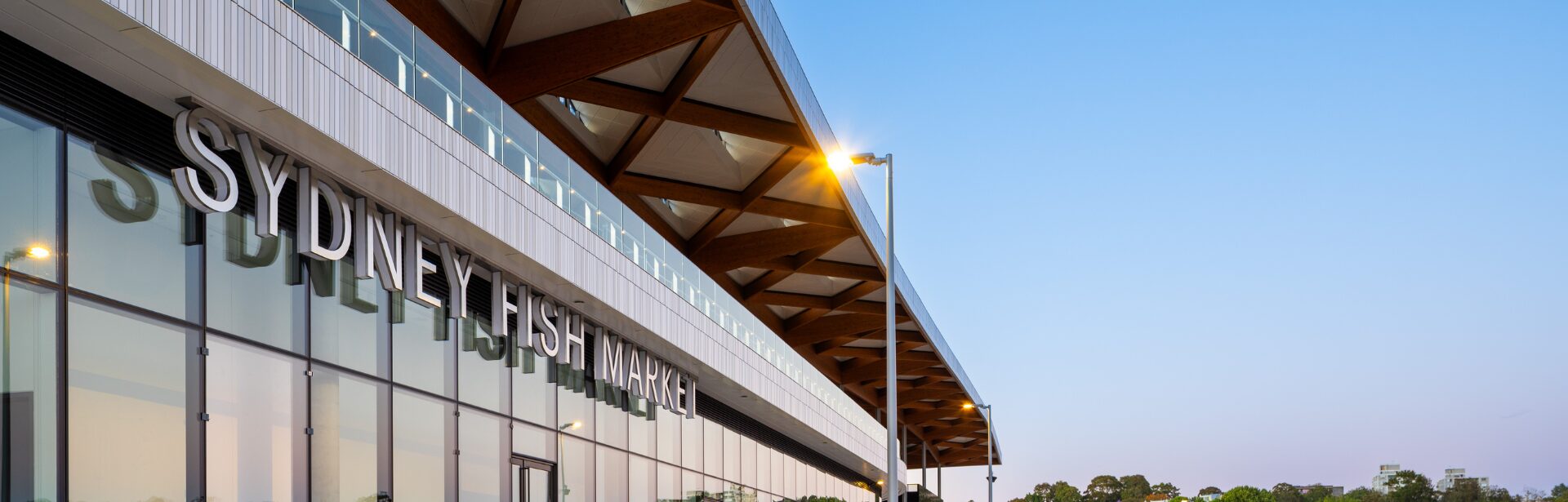
With the opening of an expansive new site at Blackwattle Bay, we explore how this uniquely Australian marketplace evolved from rambling beginnings to a harborside institution.
‘Sydney is most abundantly supplied with fish,’ begins an article on the early history of the Sydney Fish Market, printed in the Sydney Evening Press on 2 July, 1909.1 It is a sentiment which still rings true to this day. From boldly striped tiger prawns to pearlescent Sydney rock oysters and delicate fillets of flathead, Sydney is known for spectacular seafood, and fish features prominently on menus and plates across the city.
At the centre of this culinary obsession lies the Sydney Fish Market. The beating heart of fish trade in the city, it’s an icon of Sydney, attracting millions of visitors from around the world each year. Late last month the Sydney Fish Market opened its doors to a new $836 million building at Blackwattle Bay. Attracting 40,000 visitors in its first day of operation, it marked a new chapter for the waterfront marketplace.
From rambling beginnings at Sydney Cove to a state-of-the-art site, we look back at the story of the Sydney Fish Market.

For many thousands of years, the traditional landowners of Sydney, the Gadigal people of the Eora Nation practiced a highly sophisticated and sustainable fishing culture. Fish were caught along the coast and estuaries of Sydney using tools such as bark canoes, multi-pronged fishing spears and hooks fashioned from shellfish.2
Following 1788 and the arrival of Europeans, a ramshackle fish trade gradually developed in NSW. Fishermen would directly sell their daily catches from their moored boats on the harbour while fish was also hawked around Sydney Cove and Woolloomooloo. However, an absence of formal regulation as well as a lack of ice for storage and transport meant that the quality of fish available was often not reliable. In an attempt to address regulation and continuing health concerns about the sale of fish, the first formal fish market in Sydney was constructed by the city council in 1871.3 Housed in a purpose-built building in Forbes Street, Woolloomooloo, the fast-growing population of Sydney meant the market was subsequently altered and expanded, and by 1893 it covered an entire city block bordered by Bourke, Plunkett, Forbes and Wilson Streets.
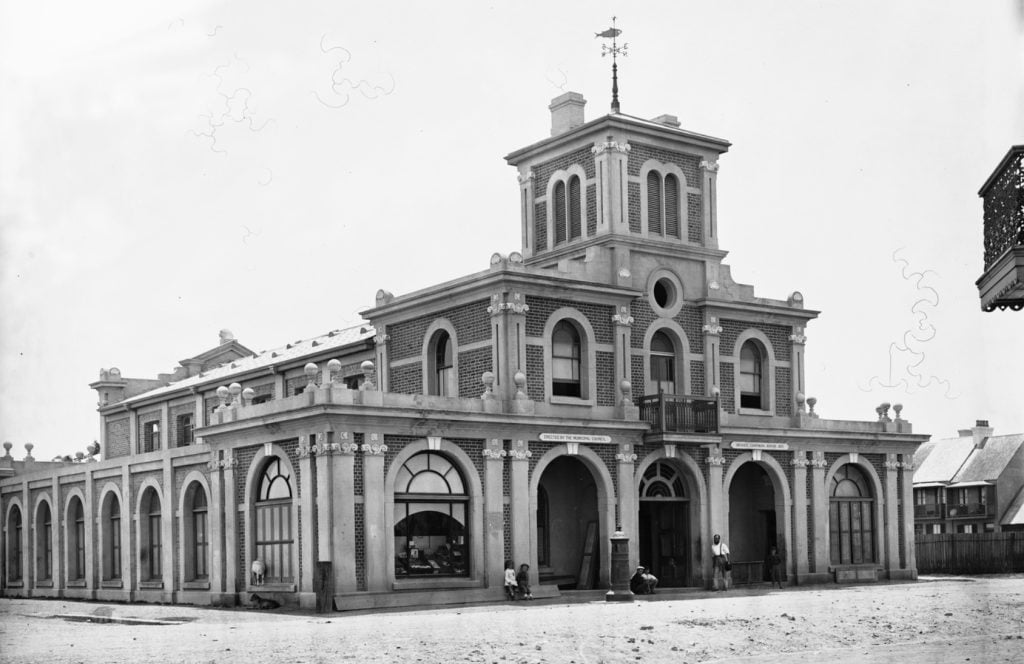
In 1891 a second, privately owned fish market opened in Redfern. Known as the ‘Southern Fish Market’ it was reportedly formed in response to the poor hygiene conditions and congestion that plagued the city-controlled site at Woolloomooloo.4 The extension of rail lines north of Sydney and its convenient location next to a train station, enabled the Redfern market to benefit from low freight costs and direct deliveries of fresh fish from coastal areas, sparking the beginning of a long-running rivalry with the Sydney City Council.
In 1897, in a move which can be inferred to deliberately undermine the rail-centric business model of the Southern Fish Market, and its capacity to directly market fish, the Sydney City Council passed a bylaw mandating that all fish sold in Sydney be first inspected at the Woolloomooloo market, which was then commonly known as the ‘Eastern Fish Market’.
A little over a decade later Sydney welcomed a third fish market. Named the ‘City Fish Market’ It was constructed as part of the produce market complex built in Haymarket by the Sydney City Council.6 While the privately-owned Redfern market continued to operate in fierce competition with the City Council, the new City Fish Market led to the demise of the old Eastern Fish Market. The building in Woolloomooloo was later sold, before it was eventually demolished.7
After 30 years of tussle over trade, the rivalry between the Southern Fish Market and the City Council came to an end by the passing of the Sydney Corporation (Fish Markets) Act 1922 (NSW) which brought into force the centralisation of fish marketing at the City Fish Market. In 1945, under the Fisheries and Oyster Farms Act, the State Government transferred control over fish marketing in NSW to the Chief Secretary’s Department, cancelling all licences held by fish agents and introducing a regulated market system.
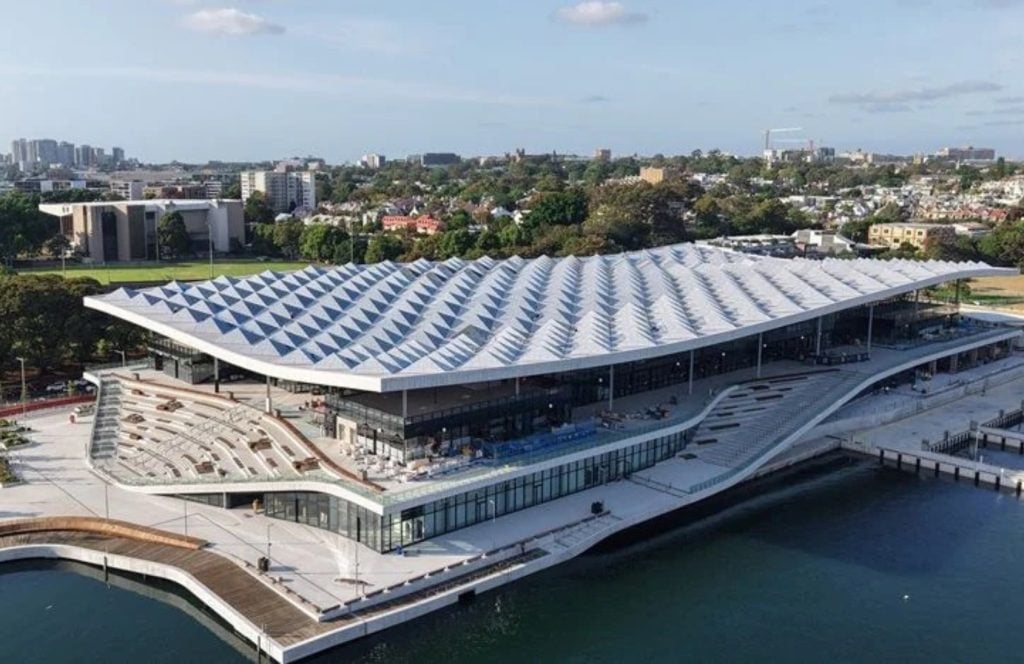
In 1964 the Fish Marketing Authority was established by the NSW State Government, establishing a regulated wholesale market. The Fish Market was moved by this organisation from Haymarket to its current location at Blackwattle Bay, Pyrmont opening there in 1966. The sale of fish at this time was via a traditional auction system, where samples of fish from each box would be held up for display for the assembled buyers and bids would be voiced until the highest price was reached.
While the auction system changed over time with technological advances, and fish marketing was deregulated, Sydney Fish Market remained at its location at Pyrmont until January 2026 when the market moved to a new site on the shoreline of Glebe in Blackwattle Bay. The gleaming building with an undulating roof echoing the appearance of fish scales is now the largest fish market in the southern hemisphere, housing over 40 specialty retailers and 19 seafood wholesalers. With everything from blue swimmer crab crumpets to King prawn po’boy’s on the menu, it’s a far cry from the market’s haphazard beginnings at Sydney Cove. Although with six million visitors expected each year, it’s clear one aspect remains unchanged: Sydneysiders enduring appetite for seafood.
- Salmon, Mary, Sydney’s Fish Market: An Early History, Evening News, Fri 2 Jul 1909.
- Aboriginal people of coastal Sydney, Australian Museum, August, 2023.
- Fish Market, Woolloomooloo, City of Sydney, Archives & History Resources.
- Ibid.
- Catchers Trust, History.
- Hay Street 1932, State Library of New South Wales
- Fish Market, Woolloomooloo, City of Sydney, Archives & History Resources.
 Facebook
 Linkedin
 Email
Email
Ex politician and skilled researcher,John Faulkner has just had published
Fishy Business
The story of Sydney and its fish markets
Well worth reading.